|
|
Simple and Convenient ...
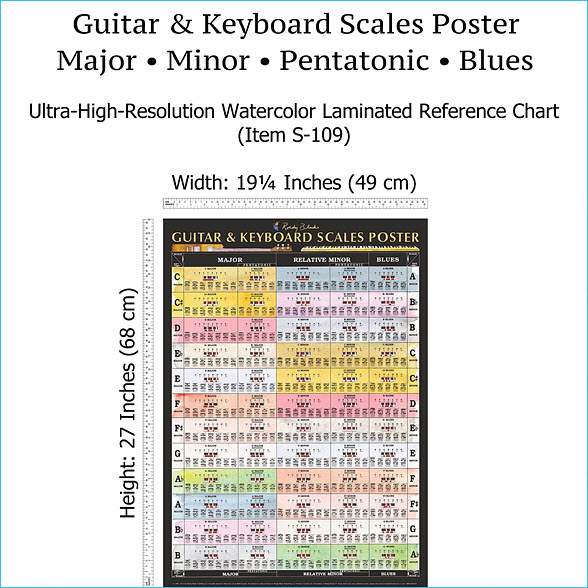
Guitar & Keyboard Scales Poster
Designed by Wayne Chase
|
|
This chart is available in 3 versions:
1.
2.
3. |
Free
PDF download—view
and print it at FULL SIZE (19" wide by 27" high) with your home
computer. This free version is identical to the paid version (see
#2 below), except that the images in the free version contain
transparent watermarks. Download it HERE
Paid PDF download ($6.95)—view and print it at FULL SIZE (19" wide by 27" high) with
your home computer. This
paid version is identical to the free version (see #1 above),
except that the images in the paid version are NOT watermarked. Download it HERE
Laminated print—SEE
BELOW ($19 + shipping).
Order it HERE.
|
|
The Most Widely-Used Scales—All on One Chart . . .
It's LAMINATED
This poster comes with a
Free Bonus:
the
Chord Progression Chart
Scroll Down For Full
Poster
Details

19" Wide x 27" High (49
x 68 cm)
|
|
ALL
ABOUT
THE
GUITAR
& KEYBOARD
SCALES
POSTER
-
Major
- Major Pentatonic
- Minor
- Minor Pentatonic
- Blues
-
On the left side of the poster, the
major scales begin with scales in the key of C Major and continue
alphabetically down the chart from row to row (C, C#,
D, etc.).
-
On the right side of the poster, the
minor and blues scales begin with scales in the key of A Minor, the
relative minor of C Major, and continue alphabetically down the chart (A,
B♭, B, etc.).
~ ~ ~ ~
"How scales are
associated and connected, that's what I've always wondered. With your Guitar and Keyboard
Scales Poster, it's making sense at last."D. Redman, Port Hope, ON
More Reviews
~ ~ ~
~
HERE'S
A
CLOSE-UP
VIEW
OF THE
SCALE
DIAGRAMS
AS
THEY
APPEAR
ON THE
GUITAR
&
KEYBOARD
SCALES
POSTER
~ ~ ~
~
"My wife bought
me the Guitar and Keyboard Scales Poster ... It
got me out of a rut in my guitar playing, and I'm moving over to try out [playing scales]
on her piano."Jack Lazic, Chicago, IL
More Reviews
~ ~ ~
~
RELATED
SCALES
GROUPED
IN
ROWS
-
Major scales appear in the same rows
as related minor scales. For example, C Major and C Major Pentatonic
scales appear in a yellowish-brown colour band. Adjacent are relative
minor scales in a blue band: A Minor, A Minor Pentatonic, and A Blues. All
five of these scale types are located in the same row.
(Colour-coding by key on the Guitar & Keyboard Scales Poster is the
same as it is on the Complete Guitar Chord Poster and the
Complete Keyboard Chord Poster.)
-
All the scales in any given row are
musically related. Therefore, the scale degrees and scale fingering
associated with each scale type within the same row are similar.
“CROSSOVER”
SCALE-LEARNING
WITHOUT
READING
MUSIC
NOTATION
-
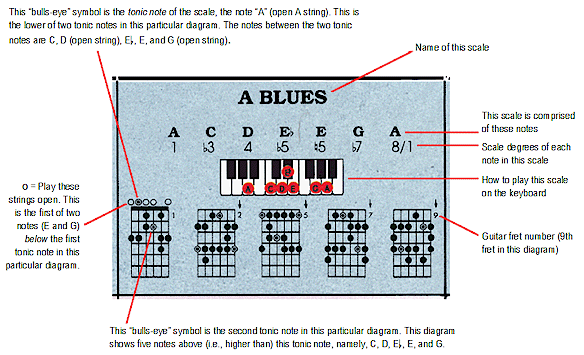
You can use the Guitar & Keyboard
Scales Poster to learn to play the same scales on the keyboard that
you play on your guitar, or vice-versa, without having to look up scales
elsewhere. Guitar and keyboard scales of the same type are conveniently
located adjacent to each other on the poster. Keyboard scale diagrams are
located just above the guitar chord diagrams for the same scale type in
each key.
-
You don't have to figure out how to
use scale formulas. And you don't need to know how to read music. The
Guitar & Keyboard Scales Poster shows you clear fingering diagrams for
all the scales for both instruments.
~ ~ ~
~
As a bass player, I
have found this chart [Guitar & Keyboard Scales Poster] very helpful. Thanks!Henry Priddle, Jacksonville, Fl
More Reviews
~ ~ ~
~
EASY
SCALE
TRANSPOSING
Suppose you know how to play the
scale "D Minor Pentatonic":
D, F, G, A, C, D
-
How can you quickly find the
equivalent scale in a different key, for example, the key of A?
-
Here's how, using the Guitar &
Keyboard Scales Poster: The red horizontal bar on the right side of the
poster contains the D Minor Pentatonic scale. The blue horizontal bar on
the right side of the poster contains the A Minor Pentatonic scale. Both
of these scales are located in the same column, the "Minor
Pentatonic" column.
-
Here's the original scale in the key
of D, followed by the same scale in the key of A:
Minor Pentatonic Scale in Key of D:
D, F, G, A, C, D
Minor Pentatonic Scale in Key of A:
A, C, D, E, G, A
~ ~ ~
~
"What I
appreciate having [on the Guitar & Keyboard Scales Poster] is the guitar and piano
scales right next to each other. This has made it a breeze to teach my band members new
arrangements ... So I can go to the piano and pick out the same melodies I used to know
only on guitar, and have a pretty good idea of what I'm doing on the piano, even though
I'm a guitar player."Dan Eldridge, Ottawa, ON
More Reviews
~ ~ ~
~
RELATED
POSTERS:
THE
COMPLETE
GUITAR
CHORD
POSTER
AND THE
COMPLETE
KEYBOARD
CHORD
POSTER
FREE
CHORD
PROGRESSION
CHART
INCLUDED!

HOW
TO
GET
THE
MOST
FROM THE
GUITAR
&
KEYBOARD
SCALES
POSTER
-
Chapter 3 on tones and overtones
-
Chapter 4 on scales
- Chapter 5 on keys and modes
- Chapter 6 on chords and chord progressions
- Chapter 9 on integrating melody with chords
www.HowMusicReallyWorks.com
HOW
MUSIC
REALLY
WORKS!
If you don’t yet
have a copy of How Music REALLY Works!, 2nd Edition, you can
read the first 6 full chapters for free at this website:
www.HowMusicReallyWorks.com
For
Performers, Students, and Instructors:
-
Most aspiring
professional musicians and instructors can sing or play an instrument with
considerable proficiency. But they don’t understand much about how music
itself really works.
-
If you want to
get ahead as a musician and/or instructor, then singing or playing an
instrument expertly is not enough.
-
If you aim to
make a living (or at least part of your living) in music as a performer
and/or instructor, you’ll do a lot better if you understand the important
aspects of how music works. For example:
-
What separates a brilliant melody from an ordinary one?
- How do great chord progressions work?
- What makes a lyric emotionally powerful?
- How is it possible to create a unique, original, signature
sound and style?
-
All of these
topics, and a lot more, are extensively and clearly covered in How
Music REALLY Works!, 2nd Edition, the world’s single most useful and
authoritative book for performers, songwriters, and music students.
-
How Music
REALLY Works!, 2nd Edition, is equally useful whether you read music
or play by ear (like most performers and songwriters). You don’t need to
know how to read music. In fact, the book has no music notation—instead,
everything you need to know about creating emotionally powerful music
AND lyrics is spelled out in clear English, with hundreds of
illustrations and examples.
-
If you don’t
already have it, you can purchase How Music REALLY Works!, 2nd Edition,
in print or PDF format, from this order page (phone, online ordering, fax,
or mail):
How Music REALLY Works!, 2nd Ed. Order Page
For Songwriters:
What's the status quo in
original songwriting everywhere?
Lame melodies.
Run-of-the-mill lyrics. Boring chord progressions.
How come?
-
The sad truth is,
99.9% of songwriters fail to rise above mediocrity. Frankly,
they’re simply clueless about effective songwriting technique. They
have no knowledge of the techniques required to write brilliant melodies,
effective chord progressions, and powerful lyrics.
-
If you write
songs as a solo artist or member of a band, you’re one in a pack of
millions. Anybody can write mediocre songs—which is exactly why the
world’s awash in second-rate, forgettable songs.
-
Writing
brilliant songs takes real know-how—which is what you need if you
expect to break away from the pack and get noticed.
-
With How Music
REALLY Works!, 2nd Edition, you can acquire that know-how. You can
quickly start learning effective technique: how to create brilliant
tunes, how to construct brilliant chord progressions, how to write brilliant lyrics.
-
Click on this link
for free access to 470 pages (6 complete chapters):
www.HowMusicReallyWorks.com
|
